
What we know: NHS pay rise 2027/28
The government is planning a 2.4% NHS pay rise for 2027/28. Nothing is agreed: the pay review body reports in 2027. What unions say and when it's paid.
The government is planning for a 2.4% NHS pay rise for Agenda for Change staff in England in 2027/28. It has told the NHS Pay Review Body, but that isn't an offer yet or a done deal. It's part of the government's written evidence, the submission it makes each year to the independent body that recommends NHS pay. Since the government published its submission on 19 October, unions have argued that 2.4% won't keep up with rising prices.
At a glance
- What's proposed? A 2.4% rise for 2027/28, after the 3.3% that staff in England received for 2026/27. It would be lower than any NHS award in the past five years.
- Is it agreed? Not yet. The pay review body makes its recommendation in 2027, and the government then decides whether to accept it. As of 20 October no date has been announced, so it isn't yet clear whether the award will be settled in time for April pay.
- When would it be paid? The government aims to pay awards as close as possible to the start of April. In England, this year's 3.3% rise took effect on 1 April 2026.
- How does it compare with prices? Prices were 3.1% higher in August than a year earlier, more than the 2.4% planned. The Bank of England expects inflation of about 2.4% over 2027/28, and says it could come in higher.
- What do the unions say? UNISON, Unite and the RCN all say 2.4% would fall short of inflation.
When would it be paid?
The 2027/28 rise can't be paid until the review body has made its recommendation and the government has decided whether to accept it.
- July 2026, the remit: the government asked the review body for recommendations on 2027/28 pay, earlier than in previous years (government's submission).
- 19 October 2026, the government's submission: the government's 2.4% plan is published, and NHS Employers makes its own submission the same day.
- 2027, the decision: the review body sends its recommendation to the government, which decides whether to accept it.
- Payment: the government aims to pay awards as close as possible to the start of the financial year. For 2026/27, NHS Employers said the increase would be paid in April salaries (announcement). If the 2027/28 award is settled after April, your payslip stays at the 2026/27 rate until it's paid, and the government's submission doesn't say whether a late award would be backdated.
A multi-year deal could change that. The governments have given the NHS Staff Council, where unions and employers negotiate the pay structure, a mandate to explore pay structure changes over up to three years. If such a deal is considered, they say they'd be open to exploring including headline pay for 2027/28 and 2028/29 in it (government's submission).
Who would get it?
The 2.4% is the department's planning figure for Agenda for Change staff in England, over 1.4 million people (government's submission).
The review body recommends Agenda for Change pay for England, Wales and Northern Ireland (39th report). Its remit letter leaves each nation to decide, and as of 20 October 2026 we found no 2027/28 position from the Welsh or Northern Irish governments, so there's no 2027/28 figure for staff there yet. Northern Ireland hasn't yet paid 2026/27's 3.3%, so staff there are still waiting for this year's rise, and the RCN is balloting nurses there on strike action until 20 November.
Scotland is the exception: it sets NHS pay without the review body, and unions there submitted their own 2027/28 claim to the Scottish Government in October. We haven't found a response from the Scottish Government yet.
How much will I get?
Nothing changes on your payslip yet: in England the 2026/27 rates took effect on 1 April 2026 (government's submission) and stay until a 2027/28 award is agreed and paid.
Take the top of band 5, £39,043 in 2026/27 (NHS Employers). At 2.4% it would rise by about £937 a year before tax. After income tax, National Insurance and your 9.8% pension contribution, your take-home pay would rise by about £601 a year, or £50 a month. If prices rise 2.4% too, as the Bank of England forecasts, keeping your take-home pay in step would take about £686, 2.4% of this year's £28,570, so you'd be around £85 a year behind prices. The gap is there because income tax, National Insurance and pension each take part of any rise. We work this out on this year's tax rules and pension rate, held fixed for 2027/28, with no student loan or other deductions. Each band's page, such as band 4, band 6 and band 7, shows every pay point.
Work out your take-home payDoes it beat inflation?
It matches the Bank of England's forecast of about 2.4% for 2027/28, and the government says that forecast carries a risk of coming in higher (government's submission). Prices are rising faster than that now: they were 3.1% higher in August than a year earlier, by CPI, the official measure of prices (ONS).
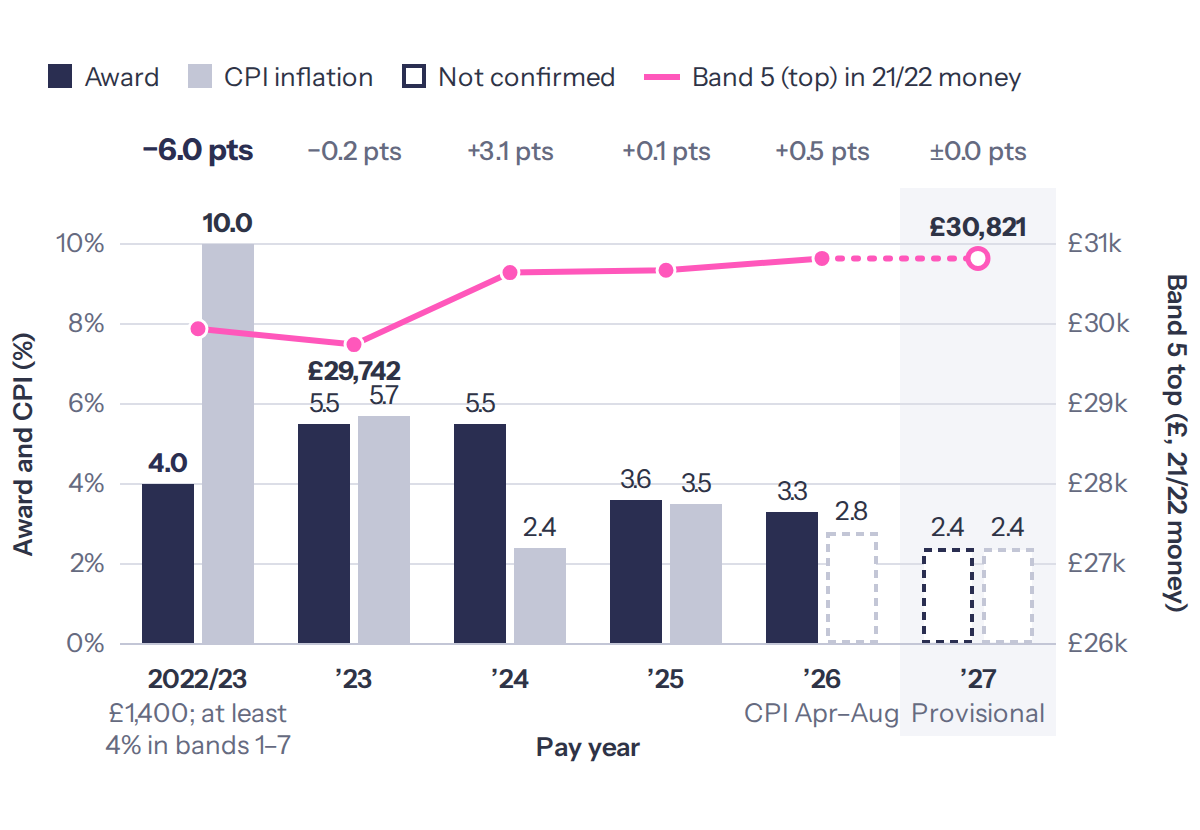
At the top of band 5, pay in 2026/27 so far buys less than it did in 2021/22, and 2.4% would hold it there if inflation matches the forecast. From 2022/23 the awards were within half a point of inflation in three of five years, ahead of it in 2024/25 and well behind it in 2022/23.
Nurses' pay since 2010
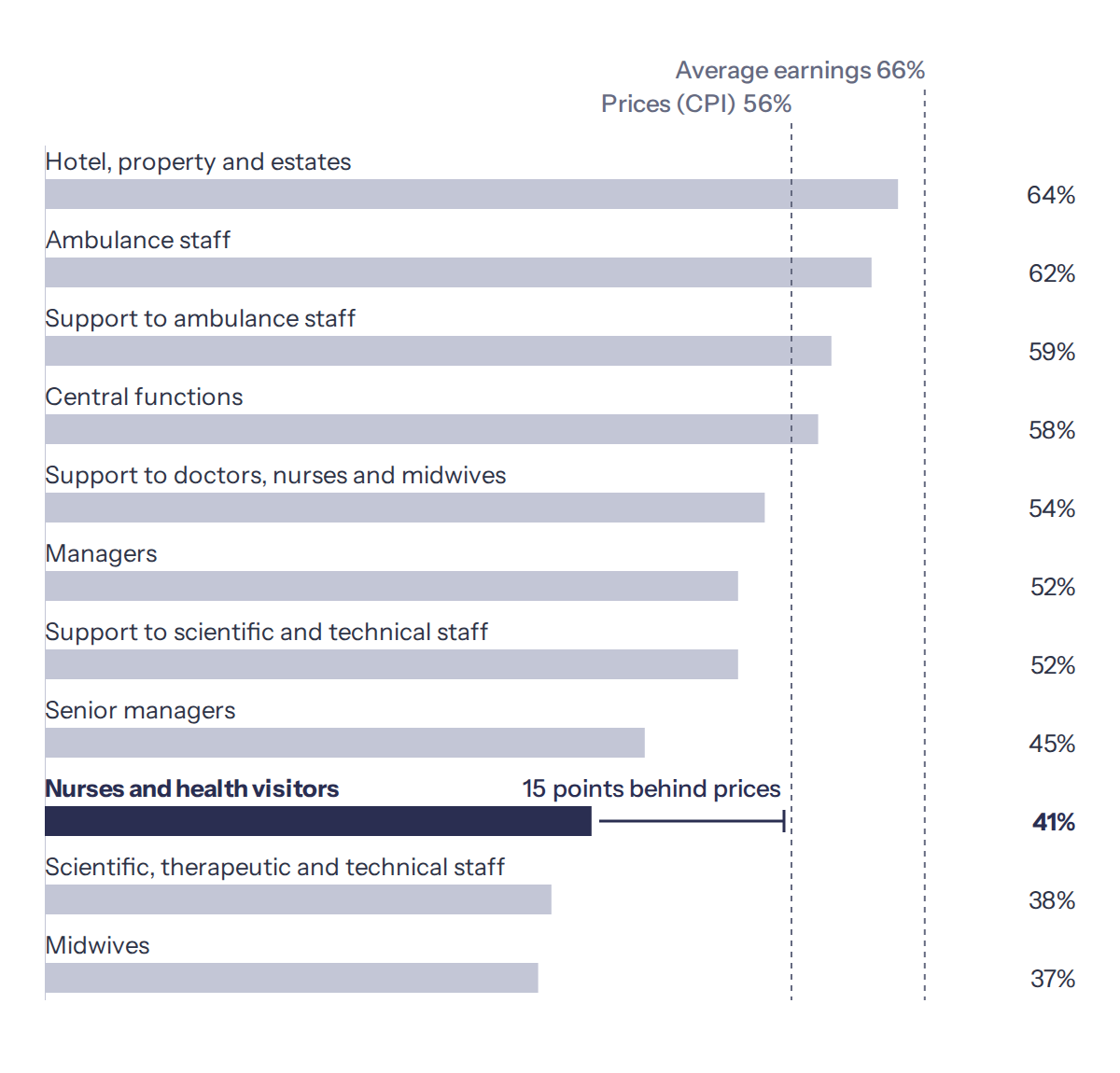
Nurses' and health visitors' basic pay rose 41% from September 2010 to October 2025, against 56% for prices and 66% for average earnings. Groups with more lower-paid staff compare relatively well with prices, though two support groups sit below the CPI line; professional groups fell further behind. The review body says this will reflect band 1 closing to new staff, bigger rises at the bottom of the scale to keep up with the National Living Wage, and some years of flat cash awards (39th report).
The lowest NHS pay and the living wage
England's lowest NHS rate is £12.92 an hour in 2026/27 (NHS Employers), 21p above the National Living Wage of £12.71. At the bottom of the scale, the review body links support groups keeping pace with prices to rises that followed the National Living Wage. The gap between England's lowest NHS rate and the National Living Wage was £1.03 an hour in 2023/24. The government puts most of the narrowing down to the living wage rising faster, not NHS pay falling (government's submission).
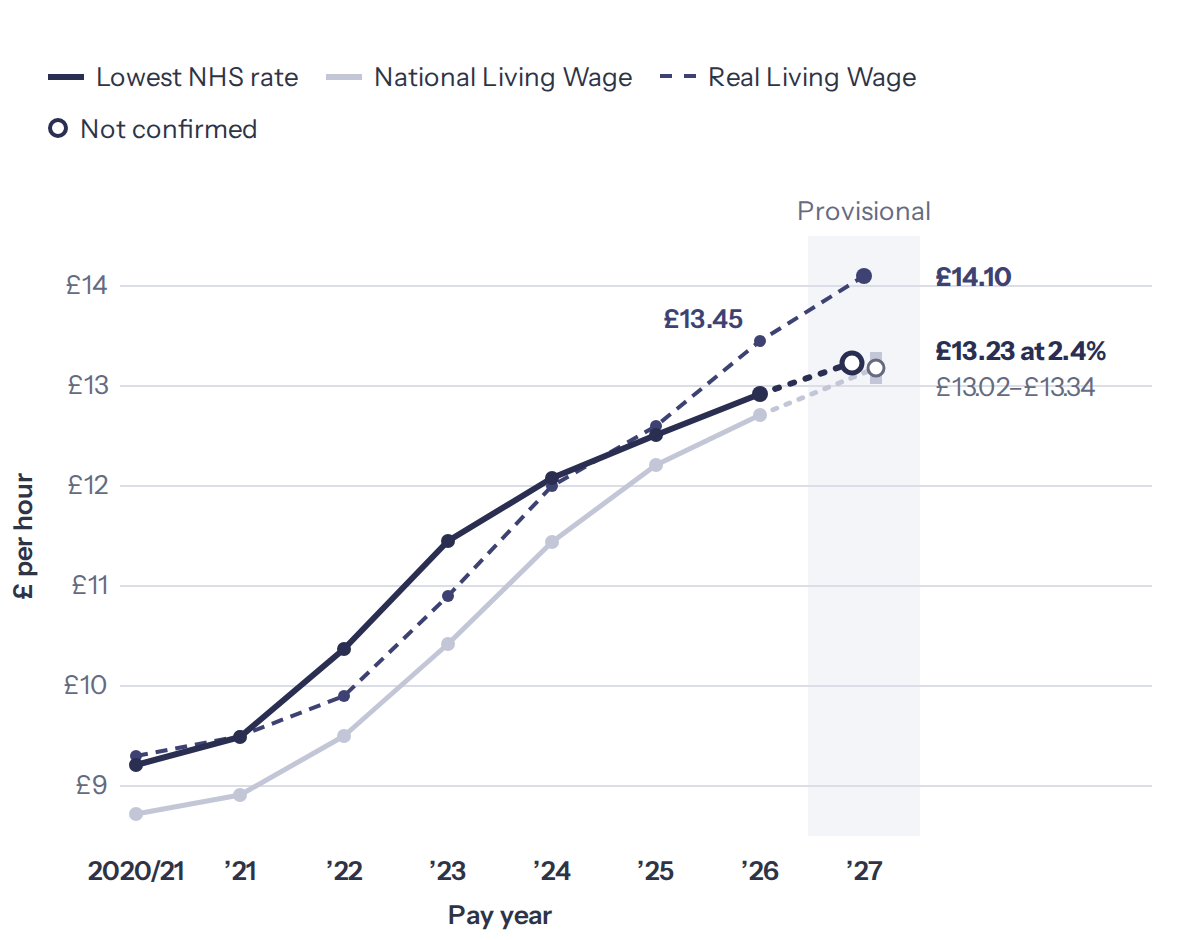
At 2.4%, the lowest rate would be £13.23 in 2027/28, inside the Low Pay Commission's indicative range of £13.02 to £13.34 for the April 2027 living wage.
Wales lifts its lowest pay points to the Real Living Wage set by the Living Wage Foundation, £13.45 an hour from April 2026 (pay letter AfC(W) 01/2026).
What are the unions saying?
- The government plans for 2.4% and says it would need to consider whether and how a higher award could be met from existing budgets (government's submission).
- UNISON has published a response opposing the figure. It says it falls short of expected inflation, and that the pay structure reform promised two years ago hasn't been delivered.
- Unite has published a response opposing the figure. It says 2.4% would be a cut in real terms, wants band 2 pay set above the Real Living Wage, and has withdrawn from the review body process.
- The Royal College of Nursing has published a response opposing the figure. It says 2.4% is below expected inflation and doesn't make up for earlier real-terms falls in nursing pay, that it has withdrawn from the review body process along with 13 other health unions, and that ministers should negotiate pay directly.
What's still to be decided?
- How much will the review body hear from staff? In the 2026/27 round most Agenda for Change unions made no submission (39th report), and the RCN says it and 13 other health unions have withdrawn this year.
- What will it say about the lowest pay points? It asked for evidence on how the National Living Wage and NHS pay are set alongside each other (39th report). The government points to the pay structure talks, which include entry pay (government's submission).
We'll post the next update here when the review body reports. Meanwhile, you can see what 2.4% would mean on your own band and pay point with our NHS take-home pay calculator.
Sources
- DHSC and NHS England written evidence to the NHS Pay Review Body, 2027 to 2028, 19 October 2026
- NHS Pay Review Body, Thirty-Ninth Report, February 2026