
NHS Pay Rise 2026/27: 3.3% and Take-Home Pay
The NHS pay rise 2026/27 is 3.3%, effective 1 April 2026. See what it means for your band with take-home pay examples and a breakdown for every UK nation.
First published on casomo.co.uk on 14 April 2026 and last updated on 2 September 2026. For the 2027/28 round, see What we know: NHS pay rise 2027/28.
The government accepted the NHS Pay Review Body’s recommendation on 12 February, giving England a 3.3% consolidated pay rise. Scotland agreed 3.75% separately; Wales matched 3.3% but adds a living wage floor lifting its lowest bands to 3.8% to 5.9%. New pay rates took effect for 2026/27, and because the award landed in February not midsummer, England has no separate backpay run for it, the first time that’s been true in six years.
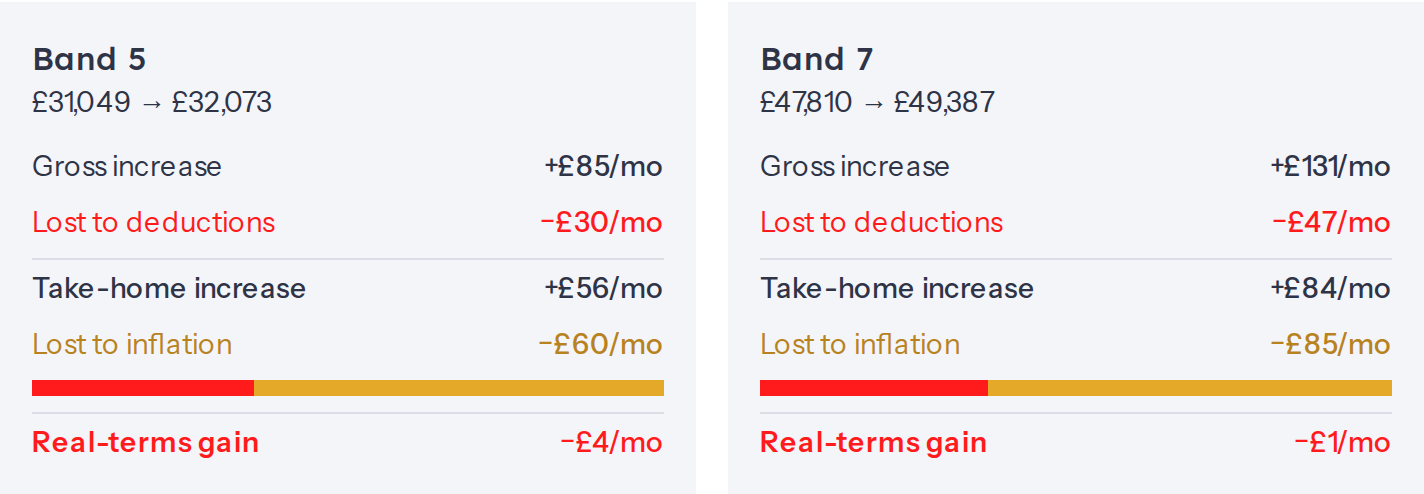
The headline is 3.3% in England (3.75% in Scotland). The number that matters is what’s left after tax, National Insurance and your NHS pension contribution. Those three deductions take a bigger bite as your pay goes up, so the actual increase in your pocket is smaller than the headline figure. Consumer prices rose 3.0% in the year to February 2026 (ONS), which also affects your purchasing power.
The timeline
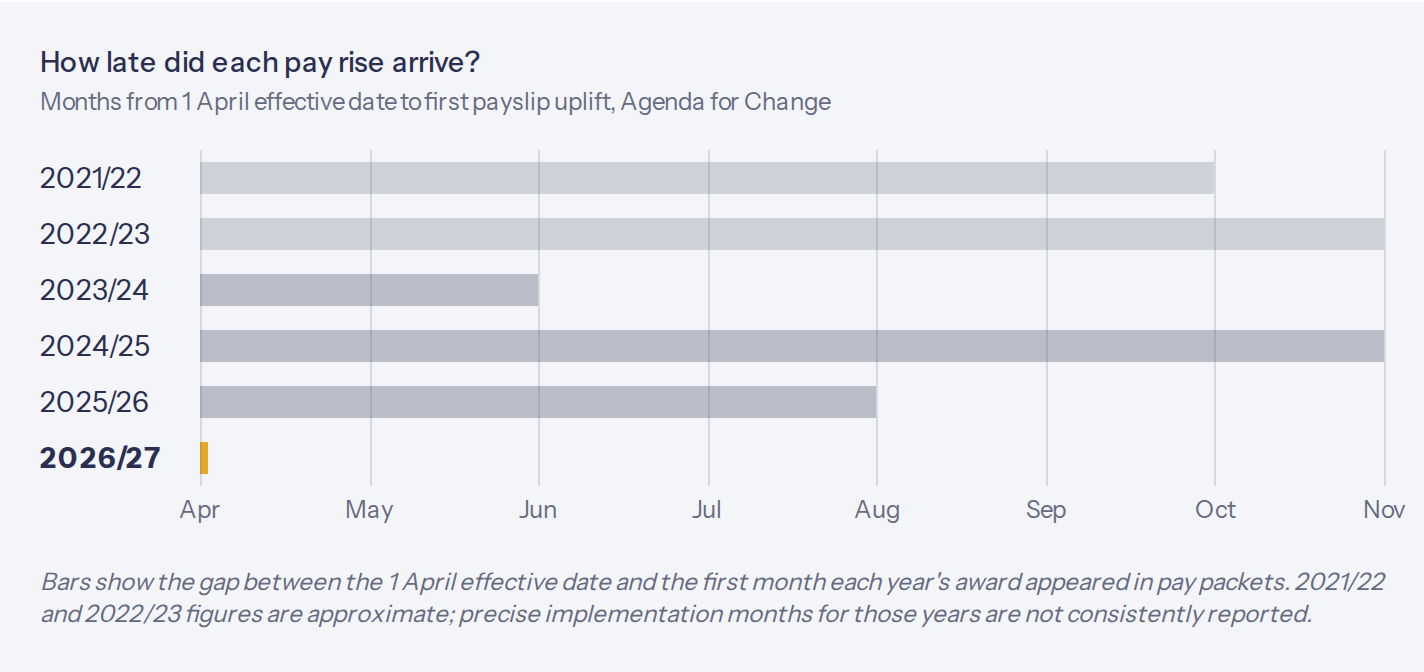
The pay round moved months earlier than in previous years. The government confirmed in its written ministerial statement that speeding up the process was a deliberate response to staff frustration with late awards. This is the first time in six years that AfC staff in England will see their pay rise in April salaries rather than waiting for backpay later in the year.
NHS pay rise by region
The 3.3% headline applies to England. Each nation negotiates its pay separately.
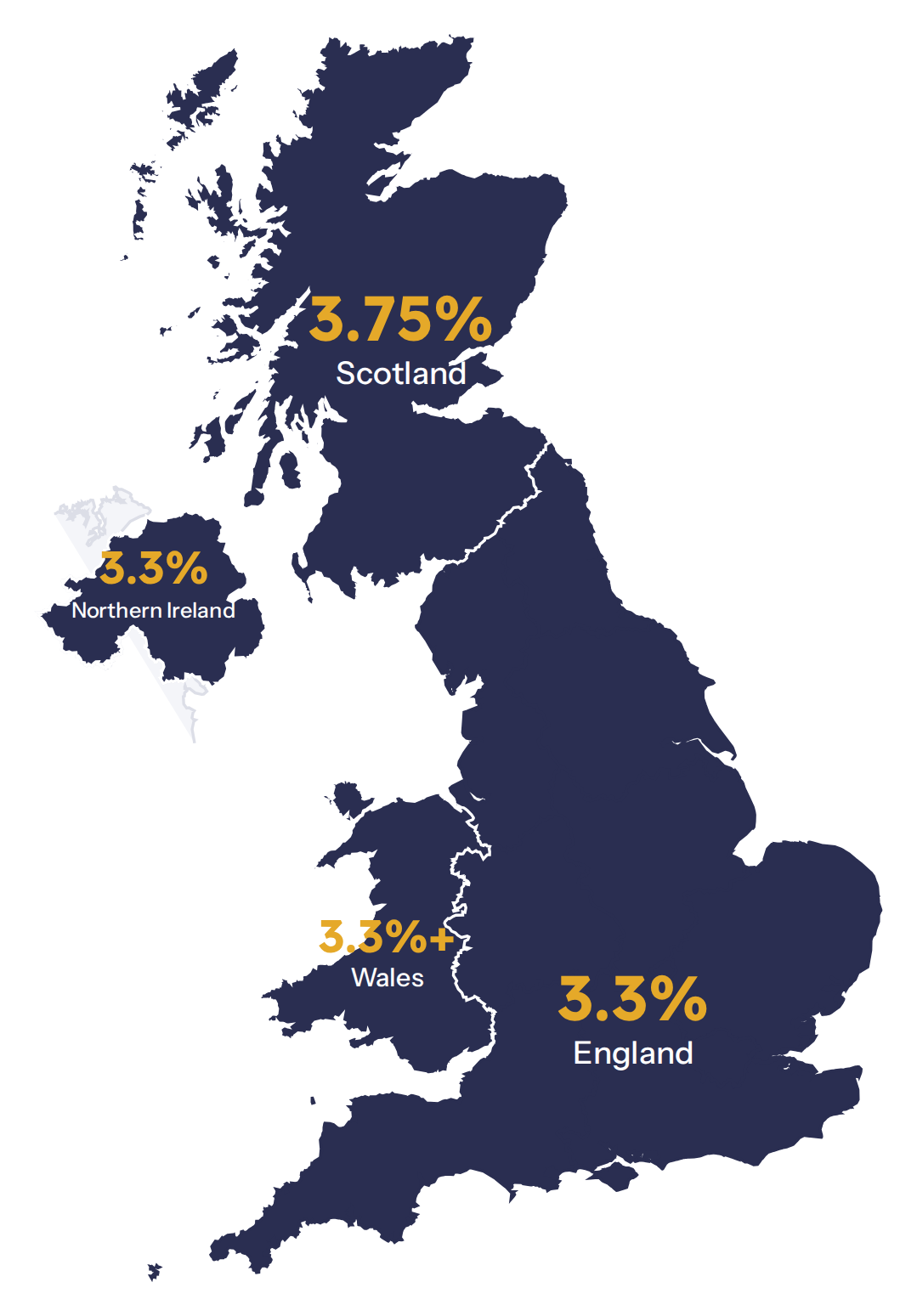
- NHS England, 3.3% from 1 April 2026. The UK Government accepted the Pay Review Body's recommendation of 3.3% consolidated on 12 February 2026, effective from 1 April 2026. No backpay is owed on it. This is the first on-time award in six years, meaning April payslips already reflect the full uplift. NHS ESR confirmed April payroll processing. Sources: NHS Employers announcement, NHSPRB 39th Report (PDF).
- NHS Scotland, 3.75% from 1 April 2026. Scotland negotiated its own two-year AfC deal (2025–2027) separately from the UK Pay Review Body process. The 3.75% for 2026/27 is the second year of that agreement, effective from 1 April 2026. The deal includes an inflation guarantee: if average CPI for the calendar year exceeds expectations, an additional payment is made so the final uplift is at least CPI + 1 percentage point. That clause triggered on 2025 CPI, so the same circular revised 2025/26 up to 4.4% and backdated it to 1 April 2025. Scottish staff did therefore receive arrears in early 2026, for that year rather than this one. Sources: Scottish Government announcement, NHS Scotland pay circular.
- NHS Wales, 3.3%+ from 1 April 2026. The Welsh Government accepted the PRB recommendation of 3.3% consolidated on 12 February 2026, effective from 1 April 2026. A real living wage floor applies to the lowest-paid staff: Bands 1, 2 and Band 3 entry receive between 3.8% and 5.9% instead of the standard 3.3%. Wales publishes its own AfC pay scales rather than adopting England’s, and its rates are above the England equivalent at every band. The gap is widest at the lowest bands, where the Welsh living wage sets the floor. Sources: Welsh Government written statement, RCN Wales, NHS Wales pay circular.
- HSC Northern Ireland, 3.3% from 1 April 2026 (pending). Northern Ireland operates Health and Social Care (HSC), a distinct system from NHS in Great Britain, though AfC pay terms broadly follow the PRB recommendations. The NI Health Minister signalled intent to match the 3.3% figure on 12 February 2026. Implementation depends on the NI Executive agreeing the 2026/27 Department of Health budget. The Executive had not confirmed the budget as of February 2026, so the award and payslip date for HSC staff are not yet confirmed. Sources: NI Health Minister statement.
Why the 2026/27 award needs no backpay wait
In most recent years, NHS staff have had to wait until summer or autumn for the headline pay award to be agreed, and then received a lump-sum backpayment covering the gap from 1 April. Last year’s 3.6% award in England, for example, was paid in August salaries with backpay to April.
This year is different. Because the government accepted the recommendation on 12 February, there was enough time for NHS payroll systems (ESR) to process the new rates in time for April salaries. You won’t see a separate “arrears” line for the 2026/27 award, because that award has none to settle. The new rate simply starts on 1 April.
Scotland is the exception worth naming. Staff there did see an arrears payment in early 2026, but it settled 2025/26 rather than 2026/27. The circular that set Scotland’s 3.75% for this year also revised last year up to 4.4% and backdated it to 1 April 2025, because that settlement’s inflation guarantee had been triggered. Full detail on the NHS Scotland pay page.
One consequence worth flagging for anyone receiving Universal Credit: when backpay lands as a lump sum in a single month, it can push your assessed income over the threshold and reduce your UC award for that month. That’s not a risk from the 2026/27 award itself, but it could become one later in 2026 if any structural reform increases get backdated in a single lump (more on that below).
What’s next: structural reform
The 3.3% is only half the 2026/27 pay story. Alongside the headline award, the government has committed additional funding to begin formal talks on structural reform of the Agenda for Change pay system. These talks are running through the NHS Staff Council and are expected to cover:
- Protecting the lowest pay bands from falling below National Minimum Wage levels as the NMW continues to rise
- Pay compression between adjacent bands, particularly at the bottom of the structure where Band 2 and Band 3 have drifted closer together
- Graduate pay, especially the step from Band 4 (unqualified) to Band 5 (qualified), which many newly qualified staff say doesn’t reflect the jump in responsibility
- Band 5 nursing job evaluation, backed by separate additional funding, to review whether current job descriptions accurately reflect the work nurses are being asked to do
Any changes agreed through these talks will be backdated to 1 April 2026, meaning some staff could receive a second pay adjustment later in the year on top of the 3.3% headline. The NHS Staff Council has submitted a report to the government on areas of consensus.
In England the uplift was set through the Pay Review Body process rather than negotiated directly, and none of the main Agenda for Change unions agreed to it. The RCN and UNISON have both published a response. Talks on structural reform continue through the NHS Staff Council, and no changes have been agreed yet.
What this means if you’re near a pay point boundary
If you’re due an incremental pay point rise around the same time as the 3.3% uplift, you can receive both. Your incremental date moves you up one point within your band, and the national pay award then increases the whole pay scale, so the two effects are cumulative.
For staff in the middle of a band, this can mean a noticeably larger April payslip than the 3.3% alone would suggest, particularly if you’ve also completed a pay progression gateway (sometimes called a KSF gateway) that unlocks further movement through your band. Our NHS take-home pay calculator can help you understand your take-home pay. Enter your band and pay point for a personalised estimate.
Frequently asked questions
When will I see the pay rise in my payslip?
The 3.3% rise was announced on 12 February 2026 and took effect on 1 April 2026. ESR confirmed the increase would be processed in time for April salaries. That is the first time in six years that staff in England haven’t had to wait for backpay.
Is there backpay, and could I get more money later?
Not for the 2026/27 award. It was agreed early enough to apply from 1 April 2026 directly, which in England is the first time in six years. Scottish staff did see arrears in early 2026, but for the year before: circular PCS(AFC)2026/1 set Scotland’s 3.75% for this year and also revised 2025/26 up to 4.4%, backdated to 1 April 2025. Structural reform talks are ongoing, and any changes agreed there will be backdated to 1 April 2026. Priorities include lower pay bands, graduate pay and Band 5 nursing. No timeline has been set for when talks will conclude.
Does the 3.3% apply across the UK?
Only in England. Wales accepted 3.3% but also applies a living wage floor that lifts the lowest pay points, giving 3.8–5.9% at the bottom. Scotland negotiated separately and agreed 3.75% for all bands. Northern Ireland hasn’t confirmed its 2026/27 figure yet.
How do I work out my exact take-home pay?
Use the NHS take-home pay calculator. It handles band, pay point, pension tier, student loan, salary sacrifice and regional tax differences, and shows 2025/26 and 2026/27 side by side.
How does inflation reduce my pay?
A 3.3% pay rise sounds generous, but consumer prices rose 3.0% in the year to February 2026 (ONS CPI). That means everything you buy costs roughly 3% more than last year. We calculate real-terms change by taking your monthly take-home increase (after tax, NI and pension) and subtracting 3% of your previous monthly net pay, the amount by which your cost of living has risen. On top of that, frozen tax thresholds mean a larger share of your new salary falls into higher tax brackets (fiscal drag), shrinking the net increase further.